Monday, November 17, 2014

Hard, Very Hard, Extremely Hard, & Ridiculously Hard to Kill! … Yeah, Really Not that "Hard" [Part 1/5: Understanding the Problem]

** PART 1/5 in the Hard to Kill Analysis Series **

Having finished the post on Mordor, the "Hard to Kill!" special rule (abbreviated H2K) came back to mind - and I realized that we had a lot of problems with that rule - since any time we played a Monster with H2K or the more "harder" versions of "Very Hard to Kill!" (VH2K), "Extremely Hard to Kill!" (EH2K), or "Ridiculously Hard to Kill!" (RH2K) - it really wasn't that hard to kill them …

In fact, the very first time we used this rule was against a Mordor Troll with the H2K rule facing off against a formation of Minas Tirith Warriors comprised of four companies.


GONDOR'S PERSPECTIVE OF THE ENSUING FIGHT
  • I have 100 120 Points of Minas Tirith Warriors; therefore 32 Models.
    • This means that I can take 28 casualties before my final company "runs away".
  • My troops are Infantry.
    • This means that the Troll (Type: Monster) will attack first - before I get to inflict any damage to him.
  • My troops have a Defense of 7 (from the front) and Resistance 1.
    • Going into hand-to-hand combat with the Troll's Strength of 7 means that he will need 4+ on his "To Hit" rolls (this is a probability of 50.0% of success and 50.0% chance of missing) and each hit will remove a soldier - again before I can even roll my dice.
                    P(4+) on a single die = P(4) + P(5) + P(6)
                                                      = (1/6) + (1/6) + (1/6)
                                                      = 3/6 = 0.50 = 50.0%

  • My troops have a Fight of 3.
    • Going into hand-to-hand combat with the Troll's Fight of 7 means that I will get no combat modifiers (pg. 47) for this fight other than Charging.
    • It also means that he will get 4 extra dice for Battle Skill when rolling "To Hit" against me.
  • My troops have a Courage of 3.
    • Getting charged by the Troll means I will need to pass a Courage Test for his Terror special rule or my fight value will be reduced to 0.
      • This would give him 7 extra dice for Battle Skill, then ...
    • I will need to roll a 7, 8, 9, 10, 11 or 12 on two dice to pass that Courage Test, meaning I have about a 58.3% chance of successfully passing the test & a 41.7% chance of failing the test.
                    P(7+) on two dice = P(7) + P(8) + P(9) + P(10) + P(11) + P(12)
                                                  = (6/36) + (5/36) + (4/36) + (3/36) + (2/36) + (1/36)
                                                  = 21/36 = 0.583 = 58.3%
  • In the current orientation of the battle, my troops have a 8 Direct Attacks with 3 Supporting Attacks.
    • This means that when I Calculate the Number of Dice I will have 8 for the Direct Company and 1 for each Supporting Company = 11 dice to roll (without a charge bonus).
  • My troops have a Strength of 3.
    • Going into hand-to-hand combat with the Troll's Defense of 7 means that I will need 6's to hit the troll, plus with the Troll's Resistance of 2 - I will need at least 2 sixes to wound (and roll on the Hard to Kill! table).
    • If I don't charge and I pass the Courage Test for Terror, this means that I will have 11 dice to roll when attacking him ...
    • If I don't charge and I don't pass the Courage Test for Terror ... oh wait ... this doesn't effect the number of Attacks, so I will still have 11 dice to roll when attacking him ... Ok, Terror isn't so scary anymore!
    • The probability of getting a 6 on a single die is 1/6 = 16.7%
***** CLEARS MIND *****

OK, OK, OK ... Long story short: I'm going to have 11 dice to roll ... each with a 16.7% chance of getting a 6 - so this means that of those 11 dice about 1-2 of them will statistically be 6's ... If I get 2 6's then I get to roll on the Hard to Kill! table ... and then looking at the table:


Wait a minute ... this says that I have a 16.7% chance of doing nothing … a 33.3% chance of adding a single wound counter, a 33.3% chance of adding two wound counters (which will only improve my chances of killing it outright on the next roll on the table), and finally a 16.7% chance of killing it outright?!? That means that 1 out of every 6 fights that I encounter with a Troll he will die outright on the first roll on the table?!? LMAO! That's what I'm talking about! And that stupid Troll cost 100 Points by himself? And Hard to Kill!?! HA! I'm going to spank that guy!

In fact, here is the Probability Table for the likelihood of obtaining a given result on the "Hard to Kill!" table based upon the number of counters on the Monster when rolling against the table:


This basically says that a Monster with the "Hard to Kill!" special rule will not last more than 4-5 Fight Phases and the likelihood of the Monster dying increases rapidly after each fight he is in. Here is an example of a few scenarios:

Case 1: A Heroic Knock-off

Let's assume that during the first Fight Phase the Troll kills 3 Gondor Warriors and the Gondor Formation has a Hero in the Command Company and scores only 2 hits on the Troll. The Gondor player then rolls on the Hard to Kill table for the 1 wound they have inflicted. They roll a 5 on the die - and then immediately the Hero uses a single point of Might to bump the 5 up to a 6 - and "Tada!" - the Troll is dead.

Case 2: A Rapid Kill

Let's assume that during the first Fight Phase the Troll kills 4 Gondor Warriors and the Gondor Formation scores 2 hits on the Troll. The Gondor player then rolls on the Hard to Kill table for the 1 wound they have inflicted. They roll a natural 6 on the die - and this means that the Troll is dead. Good Game Mr. "100 Mordor Army Points".

Case 3: A Slower Death

Let's assume that the Gondor Formation scores 3 hits during the first Fight Phase on the Troll. Since the Troll has a Resistance of 2, the 3rd hit is discounted - so still only one roll on the Hard to Kill table. They roll a 3, which means that the Troll gains 1 wound counter. During the second Fight Phase, the Gondor Formation scores 4 hits on the Troll. Now the Gondor player gets to roll twice on the Hard to Kill table … first roll is a 1. Adding the 1 wound counter that is already on the troll give a value of 2 … which means that the Troll now gains a second wound counter … totaling 2 wound counters currently on the Troll. The Gondor player still gets a second roll on the table - and if they roll a 4, 5 or 6, once they add the 2 wound counters that are already on the Troll they will get the 6 that is necessary to Outright Kill the Monster … 50% chance of success only after 3 rolls on the table. The third roll is a 4 … adding the 2 for the wound counters on the Troll - this gives 6, which kills the Troll.

Case 4: The only way this could be "Hard"

Let's assume that the Gondor Formation scores 1 hit during the first Fight Phase on the Troll. Resistance of 2 means that this hit is discounted. During the second Fight Phase, they get the 2 hits that they need to roll on the table, but as luck would have it they roll a 1 and there's nothing that can be done. During the third Fight Phase, they get 3 hits - again only a single roll on the table, but again they roll a 1 on the table … no effect. I guess this string of "bad luck" could go on for quite a while, but once the bad luck breaks then it's all down hill for the Troll.

So, a couple of things to note … 1) Once there is at least 1 wound counter on the Troll … the "ignore the blow" ability of the table goes away … Even if the second roll on the table is a 1, adding the wound counter immediately makes it a 2 - and there is another wound counter added to the Troll - he is well on his way toward death. 2) Once there are at least 2 wound counters on the Troll … the roll to kill becomes 50% (needing only a 4, 5 or 6). In fact, you are more probable to Kill the troll than to add a single or two more wound counters! 3) Once there are at least 3 wound counters on the Troll … it is pretty much game over for that poor Monster … the roll to kill becomes 66.7% (needing only a 3, 4, 5 or 6 - can only "fail" on a 1 or 2).

MORDOR'S PERSPECTIVE OF THE ENSUING FIGHT
  • I have 1 single 100 Point Troll; therefore 1 Model.
    • I need to be able to kill 28 Models of Minas Tirith Warriors before he kills me.
    • I have a Resistance of 2 and the Hard to Kill! & Terror special rules.
  • I have a Monster.
    • This means that the Troll (Type: Monster) will attack first - hopefully dealing enough damage to destroy a company or 2 before they get to attack.
  • My Monster has a Fight of 7.
    • It also means that he will get 4 extra dice for Battle Skill when rolling "To Hit" - So with my number of Attacks I'll be consistently rolling at least 7 dice against his formation in addition to charging bonuses.
    • Plus, if he fails his Courage Test for Terror, then I will have 10 dice to roll, even better!
  • My Monster has a Defense of 7 and Resistance 2.
    • Going into hand-to-hand combat with the Warrior's Strength of 3 means that he will need 6's on his "To Hit" rolls (this is a probability of 16.7% of success and 83.3% chance of missing) and if he only gets 1 hit ... it is discounted by my Resistance of 2.
    • HINT: HERE IS THE FLAWED INFLATED COMFORT LEVEL --> Plus the Troll is "Hard to Kill!" ... so even if he does get statistically lucky, it'll be "hard".
  • My Monster has a Strength of 7.
    • Going into hand-to-hand combat with the Warrior's Defense of 7 means that I will need 4+'s to hit, plus each hit will remove a model.
I'm going to have 7-10 dice to roll during each Fight Phase ... each with a 50.0% chance of getting a 4 or higher - so this means that of those 7-10 dice about 1/2 of them will statistically be 4+'s ... That means I'll be killing about 3-5 Models per Fight Phase ... In order to get through the 28 models that means I need about 6-10 Fight Phases to destroy the entire formation of Warriors. LOL, I guess that I got this! (Remember: Based upon the statistics above the most that he will be killing is about 20 Gondor Models … 5 Models per Fight Phase * 4 Phases.)

So, I think that the "problem" is somewhat understood … now, let's get on to the solution in Parts 2-5 for each of these special rules and what can be done to address the issues. Here is the plan for upcoming posts over the next week or so ...

Part 2/5 = Examining the "Hard to Kill!" rule in detail with help from a simulator and combat example.
Part 3/5 = Examining the "Very Hard to Kill!" rule with similar treatment.
Part 4/5 = Examining the "Extremely Hard to Kill!" rule with similar treatment.
Part 5/5 = Examining the "Ridiculously Hard to Kill!" rule with similar treatment.

Friday, November 14, 2014

Mordor Unit Cost Analysis & the "Monster Hero" Baseline Profile

Next up is Mordor - My initial suspect is that it will be similar to Gondor & Arnor, since it appears that those two armies were intentionally created to face-off one against another. In fact, I think that there may have been pairs like that across the development of several of the Armies. When playing against their "opposite Army", games are "fairly" well balanced for the original points, but the breakdown occurs when you step outside of those pairing since the stat lines are not normalized across all Armies (as we are attempting to do here). I also noticed that Mordor has A LOT of WarMachines - so I would suspect that a typical fielded Mordor Army would include multiple WarMachines (interestingly the Good Army that has a lot of WarMachines is The Forgotten Kingdoms with Ents [the good version of Trolls], Eagles [the good version of Nazgul], & Special Formations).

Also, with Mordor we have a new Baseline Profile that we have not yet encountered (I lied, there is already a Monster Hero profile already in the Isengard's post) ... the "Monster Hero". Typically profiles with Might have been only the Hero Profile that have no stat line entries for Ballistic Skill, Strength, Defense, & Attack; so it seems that the "Monster Hero" is a little bit like a Warrior and a little bit like a Command Hero. The way to identify the "Monster Hero" is that they are not a Command or Legendary Hero, but rather their own formation - and they still have Might.

It looks like the base profile for a "Monster Hero" character in War of the Ring is:

Monster Hero Baseline Profile:

    Cst    | Mv | F | B | S | D | A | R | C | Mt | Ar | XWpn | SpR
-------------------------------------------------------------------
 6/7/10  |   6   | 3 |  4 | 3 |  3 |  8 | 1 |  3  |  0  |  0  |     0     |   0

Key:
  • Cst = Baseline Cost of the "Monster Hero"
    • 6 = Rank and File Hero ... Equivalent of a Command Hero
      • Examples: Mordor Troll Chieftain, Isengard Troll Chieftain, & Spider Queen
    • 7 = Lesser Named Hero ... Equivalent of a Legendary Hero + 1
      • Examples: Glorfindel, Lord of the West; Quickbeam; Beechbone; Tom Bombadil; Shelob; & Dragon of Ancient Times
    • 10 = Big Named Hero ... Equivalent of an Epic Hero
      • Examples: Treebeard; The Three Hunters; Gwairhir; The Fellowship of the Ring; The White Council; Council of Wizardry; The Necromancer of Dol Guldur; The Nine are Abroad; Winged Nazgul; The Balrog of Morgoth; Buhrdur; & Gulavhar, the Terror of Arnor
  • Mv = Move value of the "Monster Hero" [Range: 0 .. INF]
  • F = Fight value of the "Monster Hero" [Range: 1 .. 10]
  • B = Ballistic value of the "Monster Hero" [Range: 1 .. 6]
  • S = Strength value of the "Monster Hero" [Range: 1 .. 10]
  • D = Defense value of the "Monster Hero" [Range: 1 .. 10]
  • A = Attack value of the "Monster Hero" [Range: 1 .. 10]
  • R = Resistance value of the "Monster Hero" [Range: 1 .. 4]
  • C = Courage value of the "Monster Hero" [Range: 1 .. 10]
  • Mt = Might value of the "Monster Hero" [Range: 0 .. INF]
  • Ar = Armor level of the "Monster Hero"
    • 0 = No Armor
    • 1 = Light/Standard Armor (Typically called "armour" in a profile and provides a +1 bonus to the Defense Value for the company in a formation)
    • 2 = Heavy Armor (Typically called "heavy armour" in a profile and provides a +2 bonus to the Defense Value for the company in a formation)
    • 3 = Special Named Heavy Armor (Sometimes called something special, like "mithril-forged heavy armour" for Hurin within the Wardens of the Keys; provides a +3 bonus to the Defense value for the company in a formation)
  • XWpn = Extra weapons that are equipped for the company in a formation
    • 0 = Hand Weapon only
    • 1+ = Any other additional wargear listed within the profile (i.e., If a profile, like Minas Tirith Archers, has "Each company has hand weapons, heavy armor and bows" this would imply that the number of extra weapons would be 1 ... 0 for the hand weapon and 1 for the bows. For the Knights of Dol Amroth: "Each company has hand weapons, heavy armour, shields and lances", this would imply they would have Ar = 2 and Xwpn = 2; 0 for the hand weapon, 1 for the shields and 2 for the lances.)
  • SpR = Magic Spells, Epic Actions & Special rules that are assigned specifically to the "Monster Hero"
    • For all heroes, regardless of level, it appears that Heroic Actions are not counted as special rules - and are effectively free
      • 0 = At the Double!, Heroic Move, Heroic Shoot, Heroic Charge, Heroic Fight & Heroic Duel (see pages 64-67 of the rules manual for details)
    • For "Monster Heroes" this value will always be the total count of Magic Spells, Epic Actions & Special rules that are assigned to the hero
      • 0 = No magic spells, epic actions or special rules (only Heroic Actions)
      • +1 for each magic spell (not discipline) and Mastery Level above 1, epic action or special rule available to the profile
When "Monster Hero" profiles are created it seems that statistics adjust the cost up or down by a set number of points:
  • Move = +/- 5 points per value point above or below 6
  • Fight = +/- 5 points per value point above or below 3
  • Ballistic = -/+ 5 points per value point above or below 4
  • Strength = +/- 5 points per value point above or below 3
  • Defense = +/- 5 points per value point above or below 3
  • Attacks = +/- 5 points per value point above or below 8
  • Resistance = +/- 5 points per value point above or below 1
  • Courage = +/- 5 points per value point above or below 3
  • Might = +/- 10 points per value point above 0
  • Armor Value = +/- 5 points per armor level
  • Extra Weapons = +/- 10 points per extra weapon
  • Special Rules = +/- 10 points per spell, mastery level of 2 or greater, special rule, or epic action 
COST OF MONSTER HERO PROFILE = {[(Cst)*5]+[(Mv-6)*5]+[(F-3)*5]+[(B-4)*-5]+[(S-3)*5]+[(D-3)*5]+[(A-8)*5]+[(R-1)*5]+[(C-3)*5]+[(Mt)*10]+[(Ar)*5]+[(XWpn)*10]+[(SpR)*10]}

Example:


Based upon the profile for the "Monster Hero" Shelob:
  • Cst = 7
  • Mv = 8
  • F = 7
  • B = 5
  • S = 7
  • D = 8
  • A = 4
  • R = 2
  • C = 5
  • Mt = 3
Wargear: "Vicious mandibles (hand weapons)."
  • Ar = 0 (The Wargear entry has nothing related to Armor.)
  • XWpn = 0 (The Wargear entry gives: 0 for the hand weapon.)
  • SpR = 7 (The Special Rules have "Ambusher, Hard to Kill!, Pathfinder (Master), Prowler, Terror, Envenomed Bite, Hunter's Pounce" listed.)
Plugging all this into the equation gives:

COST OF MONSTER HERO PROFILE = {[(7)*5]+[(8-6)*5]+[(7-3)*5]+[(5-4)*-5]+[(7-3)*5]+[(8-3)*5]+[(4-8)*5]+[(2-1)*5]+[(5-3)*5]+[(3)*10]+[(0)*5]+[(0)*10]+[(7)*10]}

= {[35]+[(2)*5]+[(4)*5]+[(1)*-5]+[(4)*5]+[(5)*5]+[(-4)*5]+[(1)*5]+[(2)*5]+[30]+[0]+[0]+[70]}
= {[35]+[10]+[20]+[-5]+[20]+[25]+[-20]+[5]+[10]+[30]+[0]+[0]+[70]}
= 200

This gives 200 Points for Shelob's profile.

 MORDOR WARRIORS


NOTE: The profile image above is the old version of the book's rule for the Hard to Kill! special rule. For the updated version of this rule, see here: Hard to Kill! Special Rule Updates

Keys:
(C) = Common Formation, (R) = Rare Formation, (L) = Legendary Formation
[I] = Infantry, [H] = Cavalry, [A] = Artillery, [M] = Monster, [MH] = Monster Hero
  • (L) [MH] The Necromancer of Dol Guldur - Underpriced by 33%
  • (L) [MH] Winged Nazgul - Underpriced by 25%
  • (R) [A] Siege Bow Battery - Underpriced by 23%
  • (L) [MH] The Nine are Abroad - Underpriced by 15%
  • (L) [MH] Winged Witch-king Nazgul - Underpriced by 10%
  • (L) [MH] Sauron, the Dark Lord of Mordor - Underpriced by 7%
  • (C) [I] Morannon Orc Warband - Accurately Priced (0% deviation)
  • (C) [H] Warg Rider Warband - Accurately Priced (0% deviation)
  • (C) [I] Mordor Orc Warband - Accurately Priced (0% deviation)
  • (R) [M] Mordor Troll - Accurately Priced (0% deviation)
  • (L) [I] Shagrat's Tower Guard - Accurately Priced (0% deviation)
  • (R) [MH] Mordor Troll Chieftain - Overpriced by 11%
  • (R) [I] Black Guard of Barad-dur - Overpriced by 11%
  • (L) [I] Grishnakh's Trackers - Overpriced by 20%
  • (R) [A] War Catapult Battery - Overpriced by 25%
  • (L) [MH] Shelob - Overpriced by 25%
  • (R) [M] Mordor Troll Drummer - Overpriced by 43%
  • (C) [I] Orc Tracker Warband - Overpriced by 50%
  • (L) [I] Gorbag's Morgul Rats - Overpriced by 50%
  • (R) [I] Morgul Stalker Warband - Overpriced by 75%
  • (R) [A] Mordor Battering Ram - Overpriced by 100%
  • (L) [I] Twilight Ringwraiths - Overpriced by 114%
  • (L) [I] Castellans of Dol Guldur - Overpriced by 145%
Applying the template from cheapest (weakest stat-wise) to most expensive (most powerful) gives the following. Of course, the Monster Heroes are at the bottom where they should be of course.
  • 10 Points per Company:
    • (C) [I] Mordor Orc Warband
    • (L) [I] Gorbag's Morgul Rats
  • 20 Points per Company:
    • (C) [I] Morannon Orc Warband
    • (C) [H] Warg Rider Warband
    • (C) [I] Orc Tracker Warband
    • (R) [I] Morgul Stalker Warband
    • (R) [A] Mordor Battering Ram
  • 25 Points per Company:
    • (C) [I] Mordor Uruk-hai Warband
    • (L) [I] Shagrat's Tower Guard
    • (L) [I] Grishnakh's Trackers
  • 45 Points per Company:
    • (R) [I] Black Guard of Barad-dur
  • 55 Points per Company:
    • (L) [I] Castellans of Dol Guldur 
  • 65 Points per Company:
    • (R) [A] Siege Bow Battery
  • 70 Points per Company:
    • (L) [I] Twilight Ringwraiths
  • 80 Points per Company:
    • (R) [A] War Catapult Battery
  • 100 Points per Company:
    • (R) [M] Mordor Troll
  • 105 Points per Company:
    • (R) [M] Mordor Troll Drummer
  • 180 Points per Company:
    • (R) [MH] Mordor Troll Chieftain
  • 200 Points per Company:
    • (L) [MH] Shelob
  • 335 Points per Company: 
    • (L) [MH] Winged Nazgul
  • 360 Points per Company:
    • (L) [MH] Winged Witch-king Nazgul
  • 445 Points per Company:
    • (L) [MH] The Necromancer of Dol Guldur
  • 540 Points per Company:
    • (L) [MH] Sauron, the Dark Lord of Mordor
  • 585 Points per Company:
    • (L) [MH] The Nine are Abroad
MORDOR HEROES


Key: (C) = Command Hero, (L) = Legendary Hero, (E) = Epic Hero
  • (E) The Mouth of Sauron - Underpriced by 41%
  • (E) Ringwraith - Underpriced by 40%
  • (C) Guard Captain BGoB - Underpriced by 33%
  • (E) Gollum - Underpriced by 17%
  • (E) The Witch-king Ringwraith - Underpriced by 15%
  • (E) Gothmog, Castellan of Minas Morgul - Underpriced by 12%
  • (E) Kardush the Firecaller - Underpriced by 9%
  • (L) Shagrat - Underpriced by 6%
  • (L) Grishnakh - Underpriced by 6%
  • (C) Orc Captain WRW - Accurately Priced (0% deviation)
  • (C) Uruk-hai Captain MUW - Accurately Priced (0% deviation)
  • (C) Black Uruk Shaman BGoB - Accurately Priced (0% deviation)
  • (C) Mordor Shaman WRW - Overpriced by 25%
  • (C) Black Uruk Shaman MUW - Overpriced by 25%
  • (L) Black Uruk Shaman STG - Overpriced by 25%
  • (L) Gorbag - Overpriced by 36%
  • (C) Orc Captain MOW - Overpriced by 43%
  • (C) Morannon Orc Captain - Overpriced by 43%
  • (C) Mordor Shaman MOW - Overpriced by 54%
  • (C) Mordor Shaman MorOW - Overpriced by 54%
  • (C) Mordor Shaman GMR - Overpriced by 54%
Oh, this is interesting ... Apparently using big name Epic Heroes with Nazgul and the Necromancer would be a cheap way under the existing rule set to have a formidable Mordor force! Sorting by the cost calculated by the template from cheapest (weakest stat-wise) to most expensive (most powerful):
  • Heroes that should cost 35 Points:
    • (C) Orc Captain MOW
    • (C) Morannon Orc Captain
  • Heroes that should cost 50 Points:
    • (C) Orc Captain WRW
    • (C) Uruk-hai Captain MUW
  • Heroes that should cost 55 Points:
    • (L) Gorbag
  • Heroes that should cost 60 Points:
    • (E) Gollum
  • Heroes that should cost 65 Points:
    • (C) Mordor Shaman MOW
    • (C) Mordor Shaman MorOW
    • (L) Mordor Shaman GMR
  • Heroes that should cost 75 Points:
    • (C) Guard Captain BGoB
  • Heroes that should cost 80 Points:
    • (L) Shagrat
    • (L) Grishnakh
    • (C) Mordor Shaman WRW
    • (C) Black Uruk Shaman MUW
    • (L) Black Uruk Shaman STG
  • Heroes that should cost 100 Points:
    • (C) Black Uruk Shaman BGoB
  • Heroes that should cost 110 Points:
    • (E) Karduch the Firecaller
  • Heroes that should cost 125 Points:
    • (E) Gothmog, Castellan of Minas Morgul
  • Heroes that should cost 170 Points:
    • (E) The Mouth of Sauron
  • Heroes that should cost 210 Points:
    • (E) Ringwraith
  • Heroes that should cost 235 Points:
    • (E) The Witch-King Ringwraith

Wednesday, November 12, 2014

What Would a WotR Blog be without a Discussion of Epic Strike?!?

Ahh - The beloved/hated Epic Strike. The "I am going to spank your puny hero's trash" go to for Epic Heroes! The "My Fight 5 Hero is now Fight 10 and more Epicly Dueling powerful than Aragorn" Special Rule ... No wonder this one special rule has caused so much contention. In fact, I think that anyone who has played even one game of WotR and used or have had it used noticed the glaring problem that this rule presents. It's not just an Epic Strike ... it is an Epic-Epic-Epic Strike and unless you could immediately counter with your own Epic Strike - it pretty much became an "I win" special rule.

As we have shown in previous posts when doing the analysis for Hero profiles:
  • Fight = +/- 5 points per value point
  • Special Rules = +/- 10 points per spell, special rule, or epic action 
Using these two point values logically together:

Epic Strike = Special Rule = +10 Points = 2*(+5 Points) = 2* (+1 Fight)

There we have it ... Epic Strike is a 10 point special rule, so the equivalent Fight Value boost for that would be an increase of 2 Fight Value Points.

Looking around the internet and on the posts on one-ring.co.uk it seems like this is actually a fairly "accepted" change for the Epic Strike rule. The rule for Epic Strike would then read as follows:


Epic Strike will increase the Fight Value of a Hero by +2 to a maximum of 10. Furthermore, if there are other special rules that have taken effect (even after Epic Strike has been applied) the minimum that a Epic Hero's Fight Value with Epic Strike applied can be reduced to is 2 (0 + 2).

The cool part about this change is that it allows all heroes to maintain their Heroic status with respect to other heroes while still providing a boost to Fight Value when needed.

Furthermore, there has been discussions about the application of an Epic Hero's abilities to the formation in which he is participating. We have found that applying the bonus from an Epic Hero for offensive abilities (like Epic Strike) should only apply to his company within the formation and not the entire formation. To accomplish this, we use a different colored set of dice for the Hero's company - just to keep them separate from he other companies in the formation. I realize that this means that the game play will slow down a little to keep track of the differentiation, but let's be honest - do we really want the game to "go fast" anyway? Of course not ... that means we have to do "other stuff" - like dishes, cleaning, watching kids, homework ... forget that! If only I could Epic Duel my responsibilities in life and call an "old school" Epic Strike, LOL!

LINKS TO OTHER RANDOM POSTS


Monday, November 10, 2014

The Kingdom of Rohan Unit Cost Analysis

Let's continue the Unit Cost Analysis with the Riders of the Kingdom of Rohan. Since this army is intended to be primarily Cavalry - it will be interesting to see how it holds up to the template, since the majority of the Armies that we have analyzed thus far have been mostly Infantry with just a little bit of Cavalry.

ROHAN WARRIORS

Keys:
(C) = Common Formation, (R) = Rare Formation, (L) = Legendary Formation
[I] = Infantry, [H] = Cavalry, [A] = Artillery, [M] = "Monster"
  • (C) [I] Oathsworn Militia - Underpriced by 20%
  • (C) [I] Rohan Royal Guard - Underpriced by 13%
  • (C) [H] Royal Knights - Underpriced by 13%
  • (L) [I] The King's Guard - Underpriced by 13%
  • (L) [H] The King's Guard Mounted - Underpriced by 13%
  • (R) [H] The Sons of Eorl - Underpriced by 10%
  • (C) [I] Oathsworn Bowmen - Accurately Priced (0% deviation)
  • (C) [H] Riders of Rohan Eored - Accurately Priced (0% deviation)
  • (C) [H] Outrider Eored - Accurately Priced (0% deviation)
  • (L) [I] Grimbold's Helmingas - Accurately Priced (0% deviation)
  • (L) [H] Elfhelm's Riders - Accurately Priced (0% deviation)
  • (L) [H] Theodred's Knights - Overpriced by 13%
  • (L) [H] Erkenbrand's Riders - Overpriced by 14%
I'm curious if any of the Rohan Players out there have ever consistently played Theodred's Knights or Erkenbrand's Riders … Apparently both of those Legendary formation (and their heroes) are overpriced for their contributing stats/abilities. 

It also seems like a valid tactic would be to have several formations of 2-3 companies of Oathsworn Militia (since they are so cheap) that you could effectively use as "pawns" to get chewed up while positioning the harder hits of your cavalry force.

Applying the template from cheapest (weakest stat-wise) to most expensive (most powerful) gives:
  • 20 Points per Company:
    • (C) [I] Oathsworn Bowmen
  • 25 Points per Company:
    • (C) [I] Oathsworn Militia
  • 30 Points per Company:
    • (C) [H] Riders of Rohan Eored
    • (L) [I] Grimbold's Helmingas
  • 35 Points per Company:
    • (C) [H] Outrider Eored
    • (L) [H] Erkenbrand's Riders
  • 40 Points per Company:
    • (C) [H] Royal Knights
    • (C) [I] Rohan Royal Guard
    • (L) [I] The King's Guard
    • (L) [H] The King's Guard Mounted
    • (L) [H] Elfhelm's Riders
    • (L) [H] Theodred's Knights
  • 50 Points per Company:
    • (R) [H] The Sons of Eorl
ROHAN HEROES


Key: (C) = Command Hero, (L) = Legendary Hero, (E) = Epic Hero

  • (C) Marshal of Rohan SoE - Underpriced by 44%
  • (E) Deorwine, Captain of the Royal Guard - Underpriced by 38%
  • (C) Knight Captain of Rohan RK - Underpriced by 33%
  • (L) Elfhelm - Underpriced by 27%
  • (E) Eomer, Marshal of the Riddermark - Underpriced by 25%
  • (C) Captain of Riders RoRE - Underpriced by 23%
  • (E) Erkenbrand, Captain of the Westfold - Underpriced by 21%
  • (C) Rohan Guard Captain RRG - Underpriced by 17%
  • (E) Eowyn, Shieldmaiden of Rohan - Underpriced by 17%
  • (E) Theoden - Underpriced by 14%
  • (L) Erkenbrand - Underpriced by 6%
  • (L) Hama - Accurately Priced (0% deviation)
  • (E) Eorl the Young - Slightly Overpriced by 4%
  • (L) Gamling - Overpriced by 10%
  • (C) Captain of Rohan OM - Overpriced by 11%
  • (C) Captain of Rohan OB - Overpriced by 11%
  • (L) Grimbold - Overpriced by 11%
  • (E) Theodred, Prince of Rohan - Overpriced by 19%
  • (L) Theodred - Overpriced by 25%
  • (E) Meriadoc, Esquire of Rohan - Overpriced by 36%

It looks to me like under the original GW WotR rules, Rohan would be the Army you would want to play if you were keen on fielding a bunch of named Epic Heroes from the books/movies. Also, consistent with Gondor & Arnor, apparently they really don't want players fielding Hobbits … they are outrageously overpriced for their functionality. 

Sorting by the cost calculated by the template from cheapest (weakest stat-wise) to most expensive (most powerful) - of course, all the awesome characters (Epic Heroes) are now at the bottom of the list … most powerful and most expensive:
  • Heroes that should cost 45 Points:
    • (C) Captain of Rohan OM
    • (C) Captain of Rohan OB
    • (L) Hama
    • (L) Grimbold
  • Heroes that should cost 50 Points:
    • (L) Gamling
  • Heroes that should cost 55 Points:
    • (E) Meriadoc, Esquire of Rohan
  • Heroes that should cost 60 Points:
    • (C) Rohan Guard Captain RRG
  • Heroes that should cost 65 Points:
    • (C) Captain of Riders RoRE
  • Heroes that should cost 75 Points:
    • (C) Knight Captain of Rohan RK
    • (L) Elfhelm
  • Heroes that should cost 80 Points:
    • (L) Theodred
    • (E) Deorwine, Captain of the Royal Guard
  • Heroes that should cost 85 Points:
    • (L) Erkenbrand
  • Heroes that should cost 90 Points:
    • (C) Marshal of Rohan SoE
    • (E) Eowyn, Shieldmaiden of Rohan
  • Heroes that should cost 95 Points:
    • (E) Erkenbrand, Captain of the Westfold
  • Heroes that should cost 105 Points:
    • (E) Theodred, Prince of Rohan
  • Heroes that should cost 120 Points:


    • (E) Eomer, Marshal of the Riddermark
  • Heroes that should cost 130 Points:
    • (E) Eorl the Young
  • Heroes that should cost 145 Points:
    • (E) Théoden
GAMLING'S ROYAL STANDARD OF ROHAN UPGRADE

First we think that the special rule for Gamling needs to include the special rules for normal banner bearers (i.e., allow re-roll of charges and panic tests - see other post for more details) but also the rule for Heroic Actions that it already has. Furthermore, to keep the point value at 50 points, we have added the caveat that Heroic Actions are NOT Epic Actions and the free Might Point only applies to the first Heroic Action called by the formation each turn. We have re-written the special rule for the Royal Stand of Rohan as follows:


Royal Standard of Rohan [Gamling]. The Royal Standard of Rohan counts as a normal banner and also has the following special rule: The first time in each turn a Hero in the formation callas a Heroic Action, roll a D6. On a score of 4 or more, the Heroic Action may be called without expending any Might. Note that this rule does not apply to any Epic Actions that are called.


      Saturday, November 8, 2014

      The "About Face!" Errata - More Game Changing than Expected ...

      Before going on with the reconfiguration movement costs, I wanted to talk a little about the official errata that Games Workshop posted for WotR. In that errata, there was a modification to the movement rules for "About Face!".

      The official Rules Errata from Games Workshop contained the following rule change:

      About Face! 
      A formation can turn to face the opposite direction at any point during its move, without using any of its movement allowance.
      I think that this rule change has a lot more impact on game play than anticipated. I am fairly certain that GW was thinking of the case of Formations with a few number of companies - or a formation that is not "spread out", because this changes the entire move mechanic where the "most expensive move a formation can make" is now a 90-degree rotation, where it used to be that the "most expensive move" was a 180-degree rotation (i.e., an About Face).

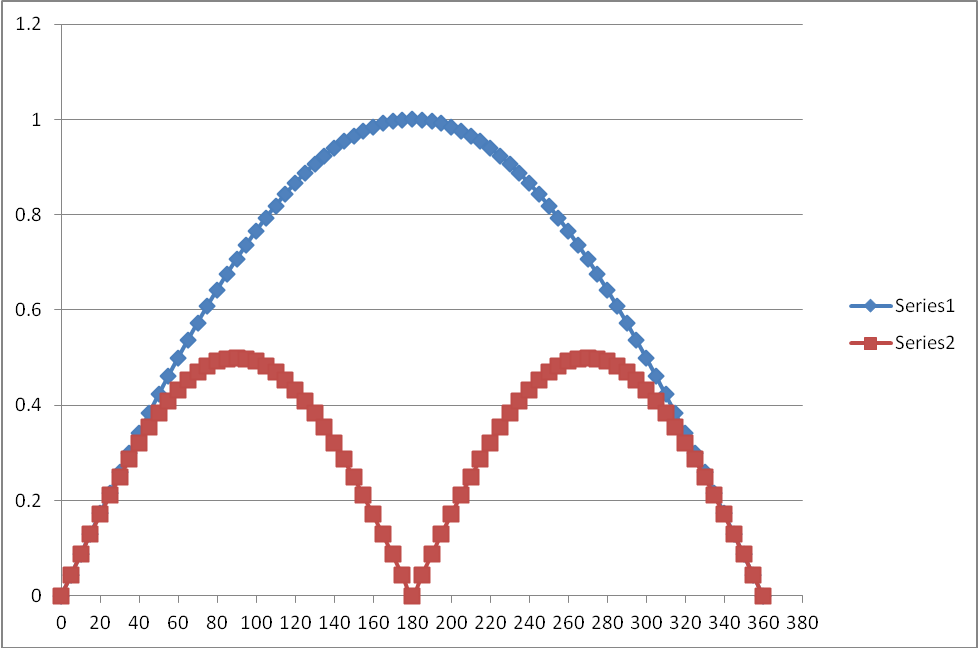
      The blue line shows the "relative cost" based upon the old rule where the red line shows the "cost" based upon the new rule for rotating formations. By "relative cost", this means that the formation's type (infantry vs cavalry), its size and current configuration of companies within the formation dictate the amount of move distance required to make the rotation and a value of "1" means that is it 100% of the cost to rotate around to an about face direction. (See the previous post where a formation of a single company's cost to rotate versus a 3x2 formation of 5 company's cost to rotate … remember that the second's was 3 times as costly.)

      Notice that the reason that the red line (under the new rule) is smaller is due to the fact that it is less efficient to move 91-180 degrees, but more efficient to instead perform a "no cost about face" and rotate back to the desired angle and then perform a second "no cost about face" to return to the original facing direction. in fact the most expensive rotation move that could be made is a 90-degree turn to the right or to the left.

      Furthermore, there was not specified limit to the number of times that a formation could perform and "About Face!" move - which means that a spell caster could effectively cast simultaneously from both the back and the front of the formation (with respect to measuring). This really becomes an issue with the "long" formations (e.g., 1x5 or 1x6 formations).


      Imagine this formation that is comprised of 6 companies of Minas Tirith Warriors and Gandalf the White are positioned as shown on the left. Assume that he casts a spell and then the formation performs an "About Face!" and then he rolls and passes his focus roll - and then casts another spell (now 360mm [just over 14"] away from where he was located originally), rinse and repeat.

      To quote from El Macho from Despicable Me 2: "Are you kidding?!?"

      This could be really annoying, really quickly … especially with those frustrating Spells of Ruin and Spells of Command … Imagine the frustration that a Mastery Level 3 Wizard like Saruman could inflict! Isengard you ARE my bane!

      I think that the way to fix the "holes" that were introduced by this rule change would be to limit the number of "About Face!" moves that a formation can perform should be limited to one per turn, and require the companies to retain their orientation within a formation - and literally turn around. For Example:


      This would mean that the wizard in the front company would only gain a distance advantage of 60mm and would not be nearly as annoying as the alternative. Is that too much to ask, considering that using a rotation about the center of the formation would cost 24.25" of movement? I mean even a Heroic Move with a Hornblower would only give this formation a total of 21" of rotational movement - still not enough to fully rotate around to an "About Face!".


      LINKS TO OTHER RANDOM POSTS
      1. GW WotR Unit Cost Controversy
      2. What About Banners and Hornblowers in Profiles?
      3. Legendary Formations and Their Point Costs
      4. The "About Face!" Errata - More Game Changing than Expected
      5. What Would a WotR Blog be without a Discussion of Epic Strike?!?
      6. Blog Introduction
      7. WotR Army Roster Sheet - Available for Download 
      8. WotR Army Roster Example 1000 Point Gondor Army
      9. Ideas for iPad Simulator of WotR

      Thursday, November 6, 2014

      Movement Types and Limits Series - Translational and Rotational Movement [Part 1/23]

      Having gone through several hundred profiles for the various Factions the average Move Value for an Infantry company/formation is about 6" and the average for a Cavalry company/formation is about 10". I want to go through a few of the various move types and which are applicable and how they can consume the distance comprising the Move Value - it may actually surprise you how short of a distance 6" really is … and the real kicker that we immediately noticed was that we were moving our formations WAY farther than their allowed Move Value within their profile would permit (so effectively we were cheating).

      ** WARNING: My Physicist Nerd side is really going to come out in this post - consider yourself warned! **

      War of the Ring is a tabletop war game that is played within a 3-dimensional Cartesian (rectangular) Coordinate Axis Frame typically measured in inches or millimeters. This is the first step in defining and describing motion (namely the Move Phase) within the game. For example, we can specify the initial position of a formation to be the starting position for a Move and can relocate the formation by one of three motions: 1) Translational Motion of the Formation, 2) Rotational Motion of the Formation, or 3) Reconfiguration of the Formation into a new Organizational Structure. All of these motions will consume some portion of the formation's Move Value unto its maximum value and once attained with prohibit further movement (of course the exception to this rule is Heroic Moves, On the Double! Moves, and other Movement adjusting special rules [e.g., Shadowstride]).

      I have noticed that even though the models and playing field are inherently 3-dimensional the game effectively takes place within the 2-dimensional plane (as if looking down from above); and the zenith (up or +y-axis) - nadir (down or -y-axis) axises typically does not consume any portion of the formation's Move Value (i.e., zenith and nadir movements are effectively "free" - which is interesting considering there could be some substantial variation of zenith/nadir directed movements over the course of the game). Let's go through a few of the movements and specify their ability/inability and how they consume the formation's Move Value.

      MOVEMENT TYPE 1: TRANSLATIONAL MOVEMENT

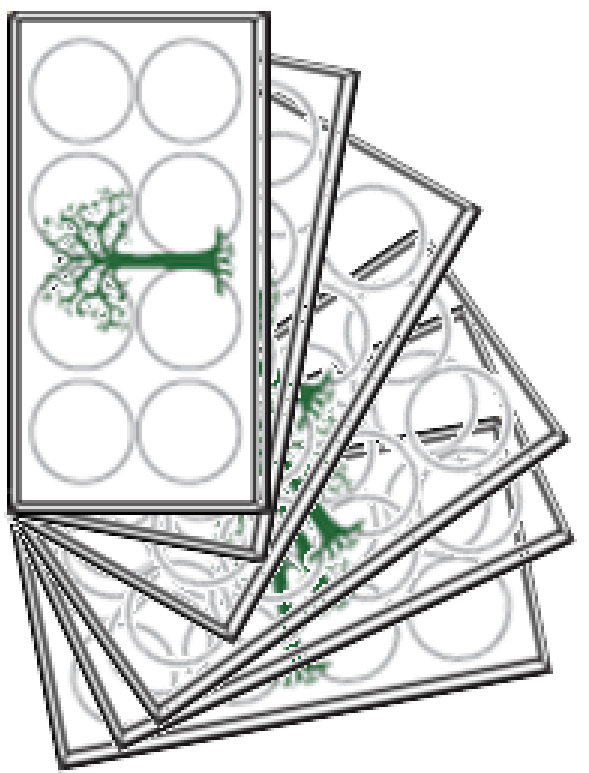
      The first type of movement we want to investigate is translational movement. This type of movement is moving in a straight line in a constant direction without any change to the formation's heading. For example, a formation comprised of 4 companies of Cavalry units could be oriented on the battlefield with a North (-z-axis) Heading. The desire may be to move this company via a translational movement to the West-North-West direction (approximately 30-degrees off of the -x-axis) while maintaining its Northern Heading. This may look something like the image to the right. Note that the maximum distance defined by the unit's Move Value for the 2x2 Cavalry Formation is shown via the blue line and the pink lines show the limit for bows (1/2 the Move Value of the formation).

      As long as the movement is strictly translational and not rotational, the formation can move up to its maximum Move Value along that straight line. In fact, and measure made from the original position the final position would be precisely the same for all companies within the formation.

      MOVEMENT TYPE 2: ROTATIONAL MOVEMENT

      The next type of movement we want to discuss is rotational movement. This is a little more complicated since this requires the overlay of a Polar Coordinate Axis Frame on top of our Cartesian Coordinate Axis Frame. The angles of Azimuth and Elevation provide rotational components for the company in 3-dimensional space with the radial distance being defined as either: 1) the quarter cross-sectional distance of all the companies within the formation from the formation's center point or 2) the formation's horizontal length rotating about one of the two front corners of the formation (called "wheeling" in Warhammer Rulesets).


      Again, since the game effectively takes place within the 2-dimensional plane ; and the zenith-nadir  axis is the only axis which is rotated about. That means that any elevation angles do not consume any portion of the formation's Move Value (i.e., the formation could be "leaning" up against a rock formation and the elevation required to get into that position does not cost extra move distance).

      For example: The two companies on the left here of Erkenbrand's Riders have a slight elevation to them. The far left company has an elevation along the +z-axis of about 15 degrees and the next formation to the right of it has an elevation along both the -x-axis and +z-axis. However, this would be effectively equivalent to all three companies laying flat on the table from a Move Value perspective.
      The Math for calculating the distance traversed by the rotation is the same regardless of the case that is employed (the only variation is the length of the radial arm); however, considering the impact of rotation by the two means available it is interesting to see which provides the most conservation of Move Value and which provides the most tactical advantage (thusly impacting the strategy of using Heroic Moves or On the Doubles!).


      I will start with a formation comprised of a single company to get the idea across and then show how it applies to a formation of more than one company.

      CASE 1 - Rotating about the Center of a Formation
      

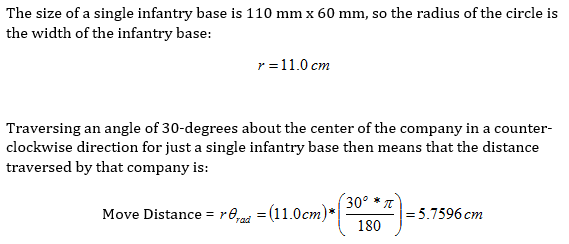
      For this case, the center of the formation would be right in the middle of the only company in the formation. The size of a standard infantry base is 110mm x 60mm - so that would imply 55.0mm in from the edges and 30mm in from the front and back. For this type of rotation, the center of the formation does not move - it becomes the pivot - and the formation rotates about that pivot. using the geometry above we can calculate the traversal distance for this company when it rotates.

      ** WATCH YOUR UNITS (lol - no pun intended) **

      3.28034 cm = 3.28034 cm * (1"/2.54 cm) = 1.29147"

      Let's take a look at the Minas Tirith Warriors and see what the means for a formation comprised of a single company.

      Since they have a Move Value of 6", this means that rotating the company by 30-degrees would use up 1.3" of their 6" Move; meaning they could translate by only 4.7" more after the rotation is complete.
      CASE 2 - Rotating about the Front Corner of a Formation ("Wheeling")

      For this case, one of the two front corners of the formation would the pivot point for the rotation of the formation. in the image to the left we have chosen the front right corner of the formation to be the pivot point. Having played with both types of rotation, this one is definitely the easier of the two to execute while participating in the game. Trying to rotate platforms with models that just don't want to stay standing is difficult enough - but trying to find the "center" that is required by CASE 1, above, is it quite difficult to keep track of it (the center) as bases are being repositioned. However, that being said - running the math shows us that this type of a rotation is actually more expensive to execute.

      This distance corresponds to a measure of 2.2676" for a single Infantry company of warriors comprising the entire formation. That would mean only a remainder of 3.7324" for any other movement anticipated to apply to the formation.

      In fact, if we "go in reverse" and try to figure out the maximum rotational distance that could be traversed by a formation comprised of a single infantry company with a Move Value of 6" ... you may be surprised what we discover:


      You are seeing that correctly - if we rotate a formation comprised of a single company by just under 80-degrees via "wheeling", we have used up the entire Move Value of the formation for the Move Phase!

      To make matters worse, the radial distance for the "wheeling" movement only gets worse for larger formations. For example - look at this 3x2 formation comprised of 5 companies of warriors:
      Just the geometric values for the circle alone have to take into consideration a radius that is 3 companies wide = 33 cm. Following the same equation above for the maximum wheeling distance that can be traversed by this formation, we find it comes out to just 26.46-degrees (and then the entire Move Value for this formation has been consumed). The only way around this is to have smaller formations (not good for getting destroyed quickly) or performing heroic actions to increase the Move Value for the formation for that turn (just as bad, because that could effectively consume some precious Might that a hero may need later in the game).

      Long story short: I think the mass majority of WotR players actually only consider translational motion as counting against the Move Value (which is incorrect). In fact I have seen players make dramatic rotations of very large flat formations where the edge company in the formation moved upward of 6x its normal Move Value (not even doable with the best special rule in the game).


      ** This Post is getting a little long ... let's save Reconfiguration Movement for the next post! **

      MOVEMENT TYPE 3: RECONFIGURATION MOVEMENT


      LINKS TO OTHER PARTS OF THE WFMC PROGRESS SERIES


        LINKS TO OTHER PARTS OF MOVEMENT TYPES AND LIMITS SERIES


        • Movement Types and Limits Series - Reconfiguration Movement of Cavalry Formations Comprised of 2-3 Companies [Part 11/23]
        • Movement Types and Limits Series - Reconfiguration Movement of Cavalry Formations Comprised for 4 Companies [Part 12/23]
        • Movement Types and Limits Series - Reconfiguration Movement of Cavalry Formations Comprised of 5 Companies [Part 13/23]
        • Movement Types and Limits Series - Reconfiguration Movement of Cavalry Formations Comprised of 6 Companies [Part 14/23]
        • Movement Types and Limits Series - Reconfiguration Movement of Cavalry Formations Comprised of 7 Companies [Part 15/23]
        • Movement Types and Limits Series - Reconfiguration Movement of Cavalry Formations Comprised of 8 Companies [Part 16/23]
        • Movement Types and Limits Series - Reconfiguration Movement of Infantry Formations Comprised of 9 Companies [Part 17/23]
        • Movement Types and Limits Series - Cavalry Movement Example 1 from Page 33 of WotR Rulebook Analysis [Part 18/23]
        • Movement Types and Limits Series - Cavalry Movement Example 2 from Page 33 of WotR Rulebook Analysis [Part 19/23]
        • Movement Types and Limits Series - Cavalry Movement Example 3 from Page 33 of WotR Rulebook Analysis [Part 20/23]
        • Movement Types and Limits Series - Reconfiguration Summary of Cavalry Formations by Company Size [Part 21/23]
        • Movement Types and Limits Series - Cavalry Restrictions of Reconfiguration by Formation Name Summary [Part 22/23]
        • Using WFMC to Verify Movement Examples [Part 23/23]